
 GIOCONDO
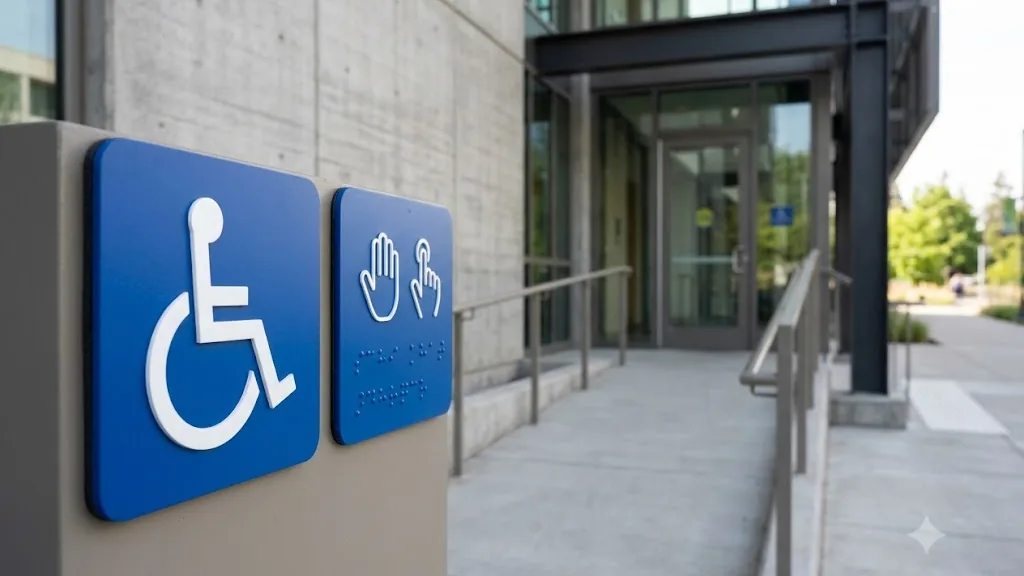
Accessibility signage often gets treated as a compliance checkbox, but it's worth remembering what it actually does: it determines whether a visitor with a visual or mobility impairment can navigate your building independently, or whether they need to rely on asking someone else for help with every turn.
Tactile and Braille signage on room identification signs - restrooms, office numbers, department names - allows visually impaired visitors to identify rooms by touch. This typically needs raised lettering alongside Braille, positioned at a consistent, accessible height throughout the building so someone can reliably find and read signage without needing to search for it at varying heights room to room.
Restroom signage specifically tends to have the most detailed accessibility requirements of any sign type in a public building - correct symbol usage, tactile characters, Braille, appropriate mounting height, and mounting location relative to the door (typically on the latch side, so it can be found without the door swinging into the person reading it).
High-contrast, clear typography benefits far more people than just those with visual impairments - low vision, ageing eyesight, and simply poor lighting conditions all make high-contrast signage easier for everyone to read quickly. This is a case where accessible design and generally good design point in exactly the same direction.
Wayfinding accessibility goes beyond individual room signs to the overall system - accessible routes need to be clearly marked, and where an accessible route differs from the main route (a ramp instead of stairs, an accessible entrance around the side), signage needs to guide someone to it clearly from the point where the choice needs to be made, not just at the accessible entrance itself.
Parking signage has its own specific requirements where accessible parking exists - correct symbol, appropriate signage height, and clear marking of the accessible route from that parking space into the building.
The practical reality is that accessibility signage requirements can vary based on your building's classification and use, and what's needed for a small office differs from what's needed for a hospital, school, or large public venue. Rather than trying to work out every applicable requirement yourself, sharing your building type and a rough sense of your current signage (or lack of it) lets us put together a signage plan that actually covers what your specific space needs.